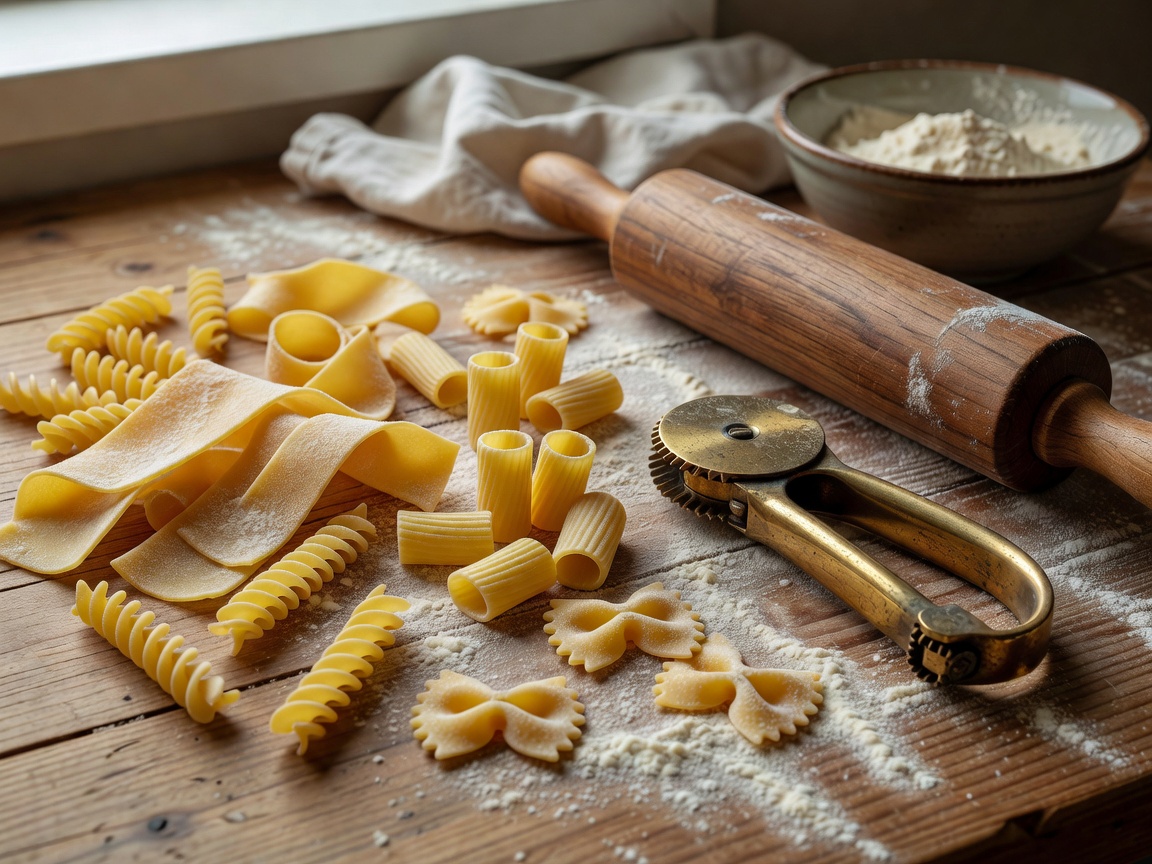
Long, short and filled
Long pasta includes strands, ribbons and sheets. A thin strand cooks quickly and presents a smooth path for a light coating. A broad ribbon has more surface and can support a substantial dressing. The point is not a rigid pairing chart; it is to notice how thickness and width change the bite.
Short shapes range from compact hand-formed pieces to tubes, shells and ridged forms. Their folds and cavities retain sauce, vegetables or small pieces of meat. Filled pasta adds a second structure: a sealed pocket protects the filling while the surrounding dough must remain thin enough to eat comfortably.
Rolled and cut methods
A rolling pin or machine compresses dough into a sheet. A knife or cutter then divides it into ribbons, squares or shapes for folding. Sfoglia is the Italian word commonly used for a sheet of rolled pasta. Thickness should be judged by the intended shape: a filled parcel needs strength at the seam, while a delicate ribbon can be thinner.
Hand shaping changes the surface. Fingers pinch, drag, roll or press the dough against a board. These actions create ridges and irregularities. The variation is part of the technique, not automatically a defect.
Extrusion and dough texture
Extrusion forces dough through a die. Bronze dies can create a rougher surface, while other dies create a smoother finish. The resulting shape may be hollow, twisted or ridged. In a workshop, the important concept is pressure: dough must be firm enough to hold its profile, but workable enough to pass through the equipment.
Dough texture depends on flour, liquid, mixing, kneading and rest. A dry dough may crack during shaping. A wet dough may cling to tools and lose definition. Adjustments should be gradual. Food safety still matters: use clean equipment, separate raw ingredients appropriately and follow the instructor’s cooking guidance.
Regional technique is learned through repetition
Names travel. Similar shapes appear under different names, and a regional technique may have several household versions. Learn the movement before memorising a label. Watch where the thumb presses, how much dough is cut, and whether the board is smooth or ridged.
Shape-to-sauce relationships are practical rather than absolute. A rough surface can hold an emulsion. A tube can carry sauce inside. A small form can distribute through a vegetable or bean preparation. Regional tradition supplies the context; the cook still responds to ingredients and texture.
Technique checklist
- Identify dough type and target thickness.
- Observe whether the surface is smooth, ridged, folded or hollow.
- Ask how the shape is usually cooked and served.
- Practise one movement repeatedly before changing size.
- Record the regional name and any alternate names.